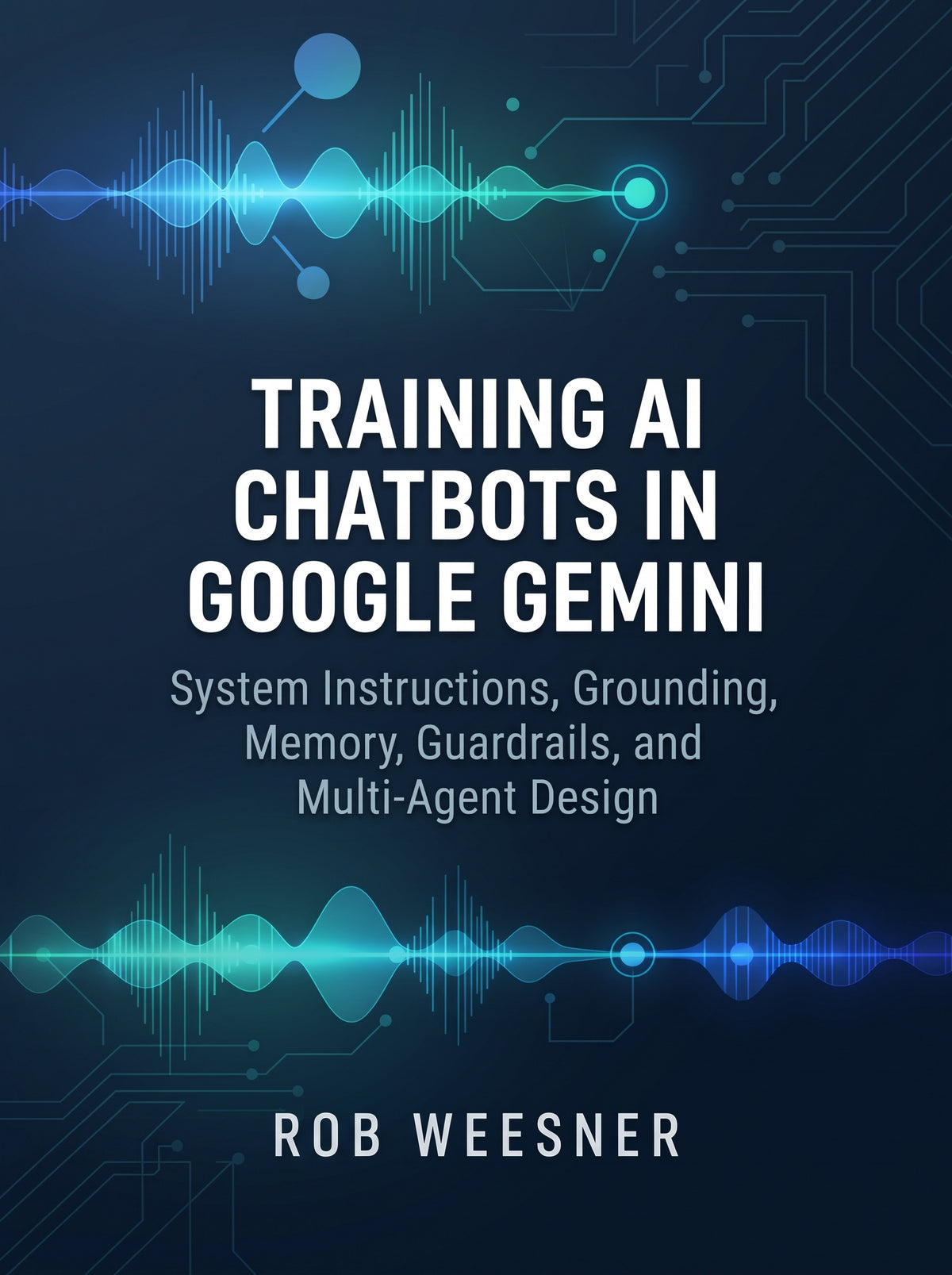
Training AI Chatbots in Google Gemini: System Instructions, Grounding, Memory, Guardrails, and Multi-Agent Design
Training AI Chatbots in Google Gemini: System Instructions, Grounding, Memory, Guardrails, and Multi-Agent Design
1 x PDF Digital Download
Stop Patching Fragile Chatbots. Start Engineering Conversational Systems That Hold Up in the Real World.
Most AI chatbots sound impressive on Turn 1—and fall apart by Turn 6.
Maybe yours invents a shipping policy that isn't in your documentation when a customer asks a specific question. Maybe it sounds warm and crisp at the start of a chat, then turns repetitive, overly wordy, or strangely robotic halfway through. Maybe it caves immediately when a user pushes back with a false assumption ("Are you sure? I thought it was 30 days..."), skips a required verification step before taking action, or gets stuck repeating generic advice instead of handing off cleanly to a human.
When that happens, most builders do one of two things: either they keep rewriting the same prompt twenty times hoping one more sentence will make the model behave, or they assume chatbots are too unpredictable for real workflows.
Both reactions miss the real reason chatbots fail. Training a modern chatbot in Google Gemini does not mean retraining neural network weights from scratch—it means conditioning runtime behavior, grounding every claim in verified sources, managing state across turns, scoping tools safely, and testing against real multi-turn failure modes.
Training AI Chatbots in Google Gemini: System Instructions, Grounding, Memory, Guardrails, and Multi-Agent Design by Rob Weesner gives you the complete, practical blueprint for doing all of that cleanly.
Whether you are building a customer support assistant, an internal team knowledge bot, a client intake workflow, a product specialist, or an educational tutor, this book shows you how to condition Gemini chatbots so they stay accurate, grounded, candid, safe, and consistent across real conversations.
What "Training" a Gemini Chatbot Actually Means
In traditional machine learning, training meant assembling massive labeled datasets, running expensive training jobs, and saving custom weight checkpoints. With modern frontier models in the Google Gemini ecosystem, conditioning is faster, sharper, and far more adaptable—provided you pull the right levers in the right order.
In this book, you learn how to use four distinct conditioning layers without confusing them:
- System Instructions & Priority Rules: Establishing role, scope boundaries, grounding rules, tone, and an explicit priority hierarchy so higher-stakes rules always win when tensions arise.
- Few-Shot Demonstrations: Showing concrete input-output exchanges so your chatbot internalizes conversational rhythm, clarifying questions, gentle premise corrections, and clean refusals far faster than abstract rules alone allow.
- Knowledge Grounding & Retrieval: Supplying authoritative reference documents, catalogs, SOPs, and hybrid search results—with explicit provenance and abstention rules—so answers come from your real facts rather than generic guesswork.
- Selective Weight Adaptation (Fine-Tuning): Knowing when prompting, grounding, tools, and structured schemas already solve the problem—and when specialized weight tuning actually earns its maintenance cost.
Climbing those levers in sequence saves wasted hours and prevents the classic trap of trying to solve a missing document or ambiguous rule with endless prompt rewrites.
Inside the Ebook: 14 Chapters Across Five Practical Parts (+ Appendices)
Part I: Foundations of Chatbot Conditioning
- Chapter 1 — What "Training" an LLM Chatbot Actually Means: Demystifies in-context conditioning, grounding, tools, and fine-tuning; breaks down the five most common reasons live chatbots fail in the wild; and helps you write a focused Chatbot Charter before touching a prompt.
- Chapter 2 — Designing High-Signal System Instructions: Breaks down the Six Building Blocks of a clean system prompt (Role & Mission, Priority Hierarchy, Scope & Boundaries, Grounding & Truth Rules, Conversation & Tone Style, and Output & Action Contract), shows how to spot hidden rule contradictions, and curbs multi-turn drift and boilerplate repetition.
- Chapter 3 — Few-Shot Conditioning & Behavioral Calibration: Shows why concrete demonstrations calibrate nuance better than extra prose rules, introduces the Four Core Few-Shot Archetypes (Happy Path, Ambiguous/Clarifying Turn, False-Premise Correction, and Boundary/Abstention/Handoff Turn), and helps you avoid style overfitting and stale examples.
Part II: Knowledge Grounding & Context
- Chapter 4 — Grounding Chatbots in Your Own Knowledge Base: Covers Direct Long-Context Grounding in Gemini, preparing an "AI-ready corpus" (eliminating conflicting drafts, adding metadata headers, and using clean Markdown/tables), framing sources with XML tags, preserving prefix stability for caching, and enforcing closed-book grounding rules.
- Chapter 5 — Hybrid RAG, Citations, and Abstention: Explains why naive single-vector RAG breaks in multi-turn chat—and shows how to build a Three-Stage Hybrid RAG Pipeline (Contextual Chunking with provenance headers, Dense + BM25 Hybrid Search with Reciprocal Rank Fusion, and Reranking + Parent-Document Expansion), rewrite conversational pronouns across turns, enforce access controls before retrieval, attach inline citations, and abstain cleanly when evidence is missing.
-
Chapter 6 — Persistent Memory & User State: Separates short-term session state from distilled long-term memory (Semantic Preferences, Episodic Outcomes, and Procedural Rules) using an asynchronous
Extract → Consolidate (ADD/UPDATE/NOOP/DELETE) → Injectpipeline with active/archived status tracking, real-time user overrides, and strict tenant/PII isolation so old facts never poison new chats.
Part III: Tools, Actions & State Control
-
Chapter 7 — Giving Your Chatbot Real Capabilities: Walks through Gemini's four-step function-calling loop and four control modes (
AUTO,VALIDATED,ANY,NONE), shows how to design intent-clear, non-guessing tools with self-correcting error responses, introduces Model Context Protocol (MCP) and MCP Apps, and enforces read/write separation, user confirmation gates, and idempotency keys on mutating actions. -
Chapter 8 — Structured Outputs & Conversation State Machines: Shows how to pair Gemini Structured Outputs (JSON Schema) with deterministic Finite State Machines (FSMs)—separating the user-facing
user_replyfromnext_state,collected_fields, andescalation_packetso multi-step workflows validate state transitions cleanly while still handling user side-questions gracefully. - Chapter 9 — Building & Prototyping Chatbots in Google AI Studio and Gemini Canvas: Shows how to sketch interfaces in Gemini Canvas, tune prompts, thinking levels, schemas, and tools in AI Studio's Prompt/Chat Lab, build full-stack web/mobile chatbots in AI Studio Build Mode with a live State Inspector drawer and Annotation Mode, and avoid "vibe-coding debt" with a disciplined build sequence.
-
Chapter 10 — Multi-Agent Chatbots in ADK: Explains when to split a monolithic chatbot into specialized agents in Google's Agent Development Kit (ADK), how to avoid the "receptionist trap" across multi-turn chats using clear
descriptionboundaries,sub_agentsvs.AgentTool,session.state/output_key, andinclude_contents, and how to trace handoffs inadk web.
Part IV: Safety, Steerability & Tone
- Chapter 11 — Defeating Sycophancy, Premise Traps, and Leading Questions in Live Chat: Diagnoses false-premise acceptance, pushback flip-flopping, framing mirroring, and leading math/logic checks—then shows how to condition calm, grounded candor via priority rules, premise-check gates, anti-flip-flop anchors, independent calculation, contrastive examples, and isolated critic checks.
-
Chapter 12 — Guardrails, Prompt Injection Defense, and Safe Escalation to Humans: Builds a Four-Layer Defense-in-Depth guardrail stack using
<untrusted_data>XML boundaries, least-privilege tool scoping, quarantined ingestion for untrusted external text, calm non-defensive refusals, and four clear escalation triggers paired with a structured Human Handoff Packet so users never have to repeat themselves.
Part V: Testing, Launch & Iteration
- Chapter 13 — Testing & Evaluating Chatbots: Moves beyond single-turn vibe checks with a Three-Tier Chatbot Eval Stack (Deterministic & Schema Checks, Multi-Turn Trajectory Checks, and Calibrated Binary Rubric Judges), shows how to assemble a 25–50 scenario Golden Conversation Set with a holdout split, and tracks groundedness, abstention accuracy, premise/guardrail hold rate, and escalation precision.
- Chapter 14 — Launching, Monitoring & Continuous Improvement Loops in Production: Guides you through staged rollouts (Shadow/Dogfood → Canary → Full Launch) with one-click rollback readiness, tracks the five vital live telemetry signals, keeps chat fast and economical via streaming, prefix caching, tier/thinking routing, and compaction, and establishes a weekly Failure-to-Fixture improvement loop plus a 7-Point Launch Gate.
Appendices A & B: Ready-to-Use Templates & Checklists
- Appendix A: Copy-and-adapt templates for your Master Chatbot System Instruction, Dual-Channel Conversation FSM JSON Schema, and Asynchronous Memory Extraction & Consolidation JSON Schema.
- Appendix B: Three practical pre-launch QA checklists covering Conditioning, Grounding & Memory, Tools, State Machines, Candor & Security, and Evaluation, Rollout & Live Operations.
Why Builders Choose This Guide
- Built for Real Multi-Turn Conversations: Every chapter focuses on what happens across real back-and-forth dialogues—clarifications, corrections, follow-ups, digressions, missing facts, and edge cases—not just isolated one-shot prompts.
- Practical Across No-Code, Low-Code, and Code Workflows: Applies whether you are configuring prompts and knowledge bases in Gemini and Google AI Studio or wiring structured schemas, tools, memory, and multi-agent specialists in ADK and custom code.
- Clear Trade-Offs Instead of Hype: Shows when direct long context beats RAG, when a single chatbot beats a multi-agent split, when to abstain or escalate to a human, and how to prove improvements with repeatable evaluations.
- Hands-On Exercises in Every Chapter: Ends every chapter with a focused exercise you can apply directly to your own chatbot project in minutes.
Who This Ebook Is For
- Creators, Founders & Operators building custom customer support, product, onboarding, or internal team chatbots in Google Gemini or Google AI Studio.
- Developers & AI Builders implementing grounding/RAG, persistent user memory, function calling/MCP, JSON state machines, and multi-agent routing in ADK.
- Product Leads, Analysts & Educators who want conversational assistants that stay accurate to source documents, resist leading premises, know when to hand off to a human, and improve systematically after launch.
What You Get
- Complete Ebook PDF: All 14 chapters across Parts I–V plus Appendices A & B (Master System Instruction template, Dual-Channel FSM JSON Schema, Memory Consolidation JSON Schema, and QA Launch Checklists).
- Custom Cover Artwork (JPG): High-resolution cover artwork ready for digital storefronts, landing pages, and ebook readers.
Stop guessing why your chatbot drifted on Turn 5 or invented an answer that wasn't in your docs. Grab Training AI Chatbots in Google Gemini: System Instructions, Grounding, Memory, Guardrails, and Multi-Agent Design by Rob Weesner and build chatbots you can actually trust in production.
Product features
Product features
Materials and care
Materials and care
Merchandising tips
Merchandising tips
Share