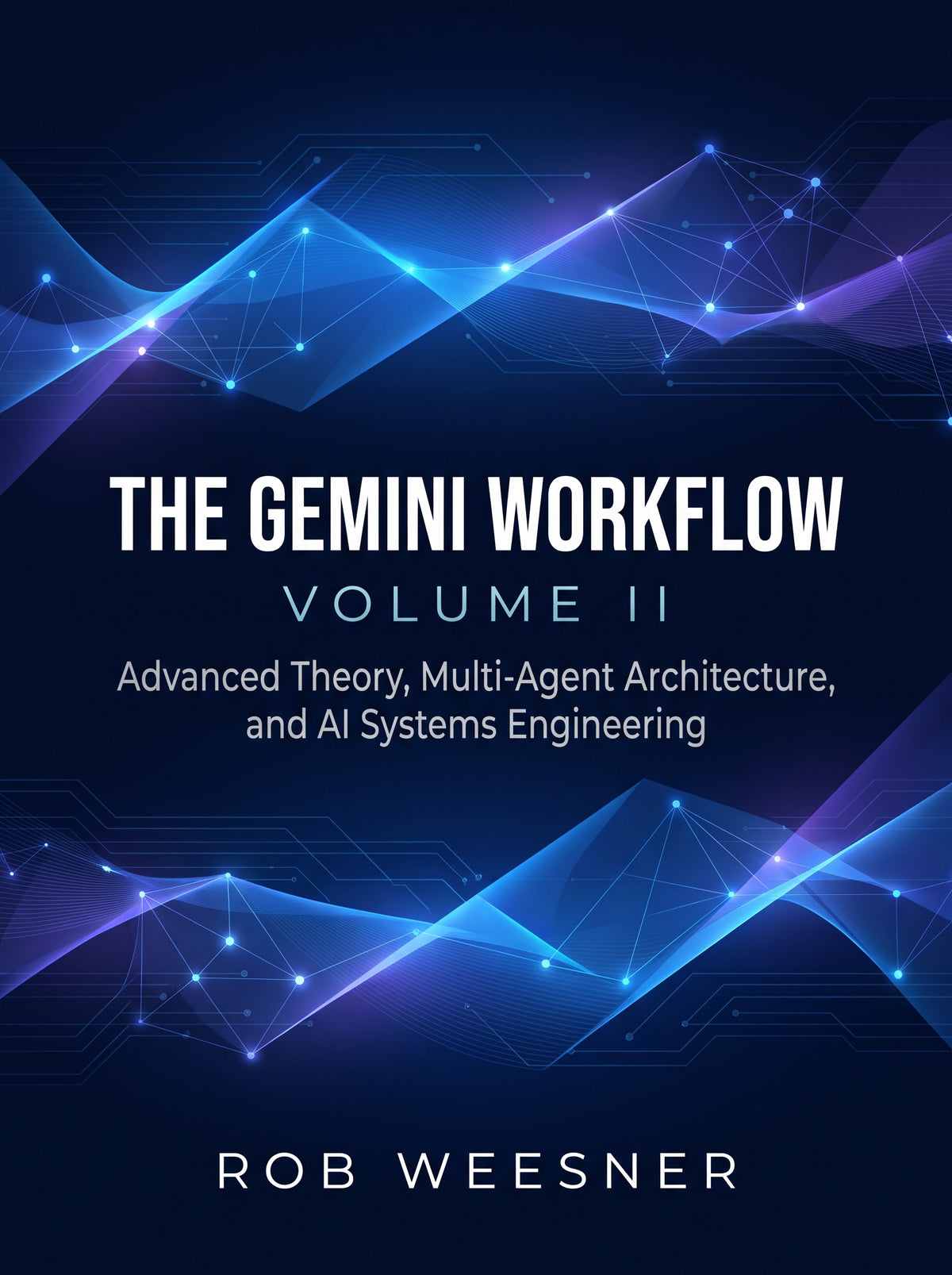
The Gemini Workflow, Volume II: Advanced Theory, Multi-Agent Architecture, and AI Systems Engineering
The Gemini Workflow, Volume II: Advanced Theory, Multi-Agent Architecture, and AI Systems Engineering
Stop Building Fragile AI Demos. Start Engineering Production-Grade AI Systems.
1 x PDF Digital Download
The Gemini Workflow, Volume II: Advanced Theory, Multi-Agent Architecture, and AI Systems Engineering
By Rob Weesner
In Volume I of The Gemini Workflow, you broke out of the "Search Bar Trap." You stopped typing vague one-liners into a blank chat window and built a repeatable Personal AI Operating System—combining Memories, modular Skills, Deep Research, Canvas, NotebookLM, Google Workspace automation, and supervised single-agent tasks.
That system already puts you ahead of 95% of professionals. Yet the moment you push further—wiring Gemini into live business operations, chaining ten autonomous steps together, directing multi-file codebases, or building customer-facing multi-agent apps—you slam straight into a second, far less forgiving wall: the Demo-to-Production Cliff.
A single prompt that succeeds 92% of the time feels like magic when you run it interactively. Chain ten of those unverified steps together into an autonomous pipeline, and simple probability turns against you: $0.92^{10}$ collapses your end-to-end reliability to 43.4%. Your 1-million-token context window—which effortlessly summarized one PDF—starts silently dropping constraints when stuffed with twenty raw API logs. Your single "God-Agent" given 25 tools begins hesitating, looping, and burning through your monthly API budget before noon. And worst of all, when you tweak a system prompt to fix one bug, you have no idea whether you just silently broke four other workflows.
Crossing that chasm requires a fundamental shift in identity: from AI Operator to AI Systems Architect.
An Operator asks, "How do I write a sharper prompt for this task?"
An Architect asks, "How do I design a system of models, context boundaries, deterministic tools, multi-agent topologies, and automated evaluation harnesses whose reliability far exceeds any individual LLM call?"
The Gemini Workflow, Volume II is the deep-technical, field-tested manual for making that leap. Written by Rob Weesner, this sequel strips away surface-level tips and dives straight into the physics, economics, and systems engineering of the modern Gemini 4 ecosystem—giving builders, technical founders, strategists, and power users the exact blueprints required to design, evaluate, and govern autonomous AI at scale.
Why Prompt Engineering Alone Hits a Hard Ceiling
Most advanced AI content online falls into one of two unhelpful extremes: either vague "10x your business with agents" hype with zero engineering substance, or dense academic papers disconnected from real APIs, latency budgets, and production failures.
The Gemini Workflow, Volume II occupies the exact middle ground where real systems are built. Every chapter is anchored in the concrete mechanics of modern frontier infrastructure—Gemini 4 Carbon, Neon, and Hydrogen, Google AI Studio (Build Mode), Google Antigravity, Google's open-source Agent Development Kit (ADK), Model Context Protocol (MCP), and the Agent2Agent (A2A) protocol.
Throughout this volume, you will master the Five Laws of Reliable AI Systems that separate brittle prototypes from enterprise-grade deployments:
- The Law of Explicit Boundaries: Never ask a probabilistic model to simultaneously invent and enforce hard rules. Separate generation from validation.
- The Law of Signal Density: A 1-million-token context window is a capacity, not an obligation. Every irrelevant token competes for attention weight and accelerates instruction drift.
- The Law of Deterministic Offloading: If a sub-task can be solved by Python, SQL, regex, or a JSON schema, never let a language model approximate it in prose.
-
The Law of Proportional Compute: Match test-time reasoning depth (
lowthroughxhigh) and model tier to the actual entropy and stakes of each step. - The Law of Measurable Iteration: You cannot engineer complex AI systems on "vibes." Without a Golden Dataset and automated evals, every change is a gamble.
Inside The Gemini Workflow, Volume II: A Chapter-by-Chapter Blueprint
Spanning 14 deep-technical chapters across 5 parts, plus two architectural reference appendices, Volume II walks you systematically from inference physics to multi-agent orchestration and production governance.
Part I: The Physics of Modern Intelligence
Before you can engineer around probabilistic variance, you must understand how modern reasoning models actually compute, allocate attention, and price context.
- Chapter 1: From Operator to Architect — The Theoretical Foundations of Probabilistic Systems Understand the structural divide between deterministic software and probabilistic inference, the mathematics of the Reliability Compounding Problem ($P_{\text{system}} = p^n$), and the three architectural levers—error-correcting loops, state isolation, and deterministic offloading—that defeat it. Maps the functional roles of Gemini 4 Carbon, Neon, and Hydrogen alongside Google's modern builder stack.
-
Chapter 2: Test-Time Compute & Reasoning Dynamics — Scaling Thinking Budgets (
lowtoxhigh) Master inference-time reasoning inside Gemini. Learn how thought tokens, cryptographic thought signatures, and the Interactions API work under the hood; why starving an agent atlowthinking often triggers the Low-Thinking Paradox (costing more per task due to wasted retry turns); how to avoid the fatalmax_output_tokenstruncation trap; and how to run the empirical Level-Sweep Protocol to lock every workflow to the lowest passing thinking tier. - Chapter 3: Context Engineering & Information Theory — Attention Dilution, Compaction, and CachingMove from prompt engineering to Context Engineering. Learn how attention dilution and context rot degrade multi-turn agents, why Sandwich & Boundary spatial layout dramatically improves rule adherence, how strict prefix stability unlocks up to 95% automatic discounts via implicit caching, and how to engineer a Three-Tier Compaction Strategy (tool-response scrubbing, rolling checkpoints, and sliding windows) to stay safely under long-context pricing cliffs and TTFT spikes.
Part II: Cognitive Architecture & Control
Turn probabilistic intelligence into predictable, auditable software components that never break downstream parsers or tell you what you want to hear.
- Chapter 4: Deterministic-Probabilistic Hybrids — Separating Reasoning from Computation Master the cognitive division of labor between semantic reasoning and symbolic execution. Dive deep into Gemini's built-in Python Code Execution sandbox (auto-retries, NumPy/Pandas/Matplotlib, 30-second boundaries), unlock Active Vision (Code Execution with Images) for programmatic cropping and visual receipt math, choose cleanly between built-in sandboxes, custom function calling, and persistent containers, and prevent Linguistic Bypass with explicit execution directives.
-
Chapter 5: Structured Outputs, JSON Schemas, and Finite State Machines in Gemini Replace brittle regex parsing with inference-layer Constrained Decoding. Expose the Silent Stripping Trap (which JSON Schema keywords like
maxLengthGemini silently ignores—requiring client-side Pydantic/Zod validation), apply four Grammar-Hygiene Rules so complex schemas never trigger400 INVALID_ARGUMENT, guard against the three edge cases that still break HTTP 200 structured outputs, and build unbreakable LLM-Driven Finite State Machines (FSMs) where deterministic code owns the state graph. - Chapter 6: Steerability, Sycophancy Mechanics, and Adversarial Alignment Loops Dissect why RLHF-trained models validate flawed premises, flip-flop under authority pressure, and mirror user bias. Enforce strict Instruction Priority Hierarchies, apply Blind Labeling and premise-check gates to eliminate bias, engineer stateless Isolated Generator–Critic–Refiner Loops capped deterministically against oscillation, and defend against Indirect Prompt Injection using XML delimiter isolation and Dual-LLM privilege separation.
Part III: Multi-Agent Orchestration
Break past the God-Agent ceiling by directing parallel swarms, standardized tool protocols, production ADK pipelines, and long-horizon autonomous coding environments.
-
Chapter 7: Orchestrator-Subagent Topologies — Directing Parallel Agents (
Neon+Hydrogen) Recognize the three scaling walls (Context Isolation, Tool Crowding, and Serial Latency) that demand multi-agent design. Compare Sequential, Hub-and-Spoke, Parallel Fan-Out/Fan-In, and Hierarchical Tree topologies; master theNeon(Hub) + ParallelHydrogen(Spokes) pattern; enforce MECE decomposition and compact 100-token JSON Handoff Contracts; and prevent distributed write collisions, quota storms, and infinite delegation loops. -
Chapter 8: Tool-Use Theory, Function Calling, and Interoperable Agent Interfaces Treat tool definitions as high-leverage prompts. Master Gemini's four function-calling modes (
AUTO,VALIDATED,ANY, andNONE) plus dynamicallowed_function_namesscoping that preserves your cached prefix. Collapse chatty microservices into coarse-grained, intent-aligned tools, return self-correcting error messages instead of raw tracebacks, master the complementary MCP (Agent-to-Tool) vs. A2A (Agent-to-Agent) interoperability stack, and protect every write tool withidempotency_keyenforcement. -
Chapter 9: Production Agent Engineering with Google's Agent Development Kit (ADK) Translate theory into clean, maintainable production code using Google's open-source ADK. Master the three agent archetypes (
LlmAgent, deterministic Workflow Agents—SequentialAgent,ParallelAgent,LoopAgent—and customBaseAgent), eliminate context rot withoutput_keyhandoffs andinclude_contents="none", avoid the classicsub_agentsTransfer vs.AgentTooldelegation trap, enforce security and logging via Callbacks, and ship reliably usingadk web,adk eval, andadk deploy(Vertex AI Agent Engine, Cloud Run, and GKE). - Chapter 10: Long-Horizon Autonomous Workflows in Google AI Studio & Google Antigravity Navigate Google's full builder continuum from Canvas to Google AI Studio Build Mode (React + Node.js server runtimes, automated Firebase Firestore/Auth, Workspace OAuth, native Kotlin/Jetpack Compose Android apps, Annotation Mode, and Cloud Run) and graduate cleanly into Google Antigravity for multi-file, agent-first software engineering. Includes the Data-First Protocol to avoid vibe-coding debt, Plan-Before-Code gates, verification-driven test loops, and Git atomic checkpointing.
Part IV: Memory & Retrieval Science
Solve the hardest data challenges in production AI: grounding across massive enterprise libraries and maintaining accurate, conflict-free state across weeks of interaction.
-
Chapter 11: Advanced Grounding — RAG vs. 1M-Token Long Context vs. Hybrid Architectures End the "RAG is dead" debate with a rigorous four-axis decision matrix (Corpus Size, Update Velocity, Query Topology, and Per-User ACLs). Learn when Pure Cached Long Context beats retrieval hands down, upgrade naive vector search to the Three-Stage Modern RAG Stack (Contextual Chunking, Dense + BM25 Hybrid RRF, and Cross-Encoder Reranking), and deploy the gold standard: Coarse-to-Fine Parent-Document Long-Context RAG paired with XML provenance tags and mandatory
INSUFFICIENT_EVIDENCEabstention gates. -
Chapter 12: Persistent Agent Memory — Episodic, Semantic, and Procedural State Across Sessions Eliminate cross-session amnesia without causing memory poisoning. Separate persistent state into three cognitive substrates—Episodic (time-decaying events), Semantic (distilled, timeless facts), and Procedural (learned
IF/THENheuristics). Engineer an asynchronous Extract → Consolidate (ADD/UPDATE/NOOP/DELETE) → Retrieve → Decay pipeline using bi-temporal schemas that eliminate "zombie facts," quarantine procedural lessons behind approval gates, and enforce hardtenant_idmulti-tenant isolation.
Part V: Evaluation & Scale
Prove your system works mathematically, optimize unit economics by 50%–90%, and lock down autonomous agents for live enterprise traffic.
- Chapter 13: Evaluation Science — Golden Datasets, LLM-as-a-Judge, and Hallucination Budgets Replace vibe checks forever with the Three-Tier Evaluation Pyramid (Deterministic Assertions, Trajectory/Tool Evals, and Calibrated LLM-as-a-Judge). Build balanced Golden Datasets anchored in real production failures and adversarial stress cases; eliminate verbosity, position, and self-preference bias using binary rubrics and position swapping; calibrate judges to $\ge 85\%$ human agreement; distinguish Intrinsic vs. Extrinsic Hallucinations; and wire automated eval gates into CI/CD and nightly production drift sampling.
-
Chapter 14: Token Economics, Latency Engineering, and Production Governance Master the financial and operational levers of scale. Slash background compute bills by 50% using Gemini's Flex and Batch inference service tiers while protecting interactive SLAs with Priority and Provisioned Throughput; engineer Cascade Routing across
Flash-Lite,Hydrogen,Neon, andCarbon; optimize TTFT vs. TPOT and streamed progress UX; centralize tool access via Cloud API Registry; and lock down production with financial circuit breakers, immutable lineage traces, pinned model snapshots, and staged canary rollouts.
Included Technical Reference Appendices
Designed to stay open right beside your IDE or architecture doc:
-
Appendix A: Reference System Architectures Four ready-to-adapt blueprint diagrams covering: (1) The Hub-and-Spoke
Neon+HydrogenSwarm with Isolated Critic, (2) Coarse-to-Fine Hybrid Grounding & Abstention Pipeline, (3) Schema-Locked Finite State Machine with Deterministic Guardrails, and (4) Asynchronous 3-Substrate Persistent Memory Engine. - Appendix B: Production Evaluation & Governance Checklists Three rapid pre-flight checklists—Context/Compute/Caching, Three-Tier Evaluation Harness, and Production Economics/Security Governance—so you never push an unverified change to production again.
Who Volume II Is Built For
- AI Engineers, Full-Stack Developers & Technical Founders moving from single-prompt prototypes to resilient, multi-agent products built on the Gemini API, ADK, AI Studio, and Antigravity.
- Technical Product Managers & Solutions Architects responsible for model routing, RAG vs. Long-Context trade-offs, latency SLAs, evaluation harnesses, and enterprise AI governance.
- Power Users & Volume I Readers who have already mastered personal Gemini workflows and want to understand the deep systems theory, JSON schemas, multi-agent swarms, and evaluation science powering the next generation of autonomous AI.
Note: You do not need a PhD in machine learning to master this book—every concept is grounded in practical architecture, clear diagrams, concrete schemas, and end-of-chapter architectural exercises. However, Volume II assumes you are ready to think in systems, data contracts, and measurable reliability rather than casual chat prompts.
Frequently Asked Questions
Do I need to read Volume I before reading Volume II?
Volume I establishes the personal productivity foundation (prompting, Memories, Skills, Canvas, NotebookLM, Workspace, and single-agent supervision). If you already use AI daily or build with APIs, you can jump straight into Volume II—though together, Volumes I and II form a complete end-to-end mastery curriculum from individual operator to production AI architect.
Is this a programming textbook or an architecture guide?
It is an AI Systems Engineering & Architecture manual. Where code, JSON schemas, or ADK Python snippets clarify a concrete production pattern (such as LlmAgent isolation, Pydantic validation, or FSM transition schemas), they are included cleanly—while keeping every chapter focused on durable architectural principles that apply across Python, TypeScript, Go, or no-code/low-code orchestrators.
How does this stay relevant as Gemini models evolve?
While Volume II covers the exact mechanics of the modern Gemini 4 lineup (Carbon, Neon, Hydrogen), ADK, MCP, A2A, and Antigravity, every framework inside—reliability compounding math, test-time compute sweeps, prefix stability, constrained decoding, isolated critics, coarse-to-fine grounding, cognitive memory substrates, and three-tier evals—represents permanent systems engineering physics that compounds with every future model release.
What format do I receive?
You receive an instant, publication-formatted PDF ebook featuring matching Volume II cover artwork, dedication, structured Table of Contents, all 14 deep-technical chapters, architectural comparison tables, chapter-end Architectural Exercises, and Appendices A & B—ready for desktop, tablet, or reference printing.
Graduate From Prompting to Systems Engineering.
Anyone can build an impressive AI demo in twenty minutes. The real competitive advantage belongs to the architects who can build AI systems that run accurately, economically, and safely on the ten-thousandth run.
Download The Gemini Workflow, Volume II by Rob Weesner now—and start engineering production-grade Gemini systems that scale.
Product features
Product features
Materials and care
Materials and care
Merchandising tips
Merchandising tips
Share