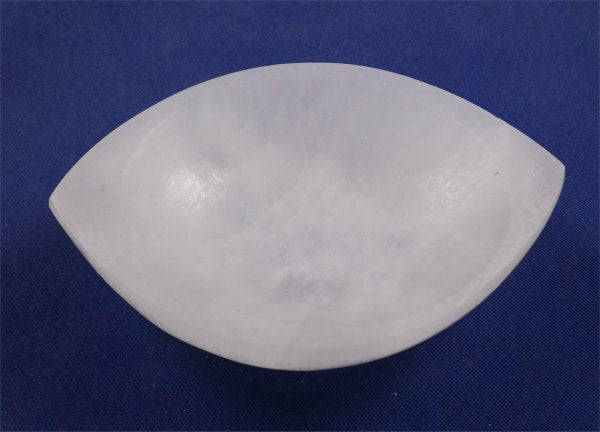
Selenite Eye Bowl
Selenite Eye Bowl
Selenite Eye Bowl
Stone Type: Selenite
Stone Cut: Eye Bowl
Stone Weight: 13 Ounces
Stone Color: White
Stone Size: 4 Inches
Location: Morrocco
History Of Selenite Eye Bowl
The history of the Selenite Eye Bowl is a convergence of ancient mineralogy and sacred geometry. While Selenite has been harvested for millennia, the carving of this mineral into functional "Eye Bowls"—vessels shaped like a human eye or featuring an engraved eye motif—is a sophisticated development in the ritual arts. These bowls represent the transition of Selenite from a raw structural material into a refined "Optical Tool" used for both the physical cleansing of objects and the spiritual "oversight" of a space.
Understanding the Energy
Selenite is famously known as "Liquid Light." Its energy is high-frequency, translucent, and exceptionally fast. Unlike most minerals, Selenite does not require "clearing" because it does not hold onto dense energy; it shatters it. When shaped into an Eye Bowl, the energy becomes focused on Vision and Purification. The "Eye" symbology transforms the bowl into a "Watcher," a vessel that scans the energetic integrity of whatever is placed within it, ensuring that your tools, jewelry, or intentions are viewed through a lens of absolute clarity.
Geological Origins and Naming
-
Composition: Selenite is a fibrous variety of the mineral Gypsum (CaSO_4 \cdot 2H_2O). It is characterized by its pearly luster and "cat's eye" chatoyancy.
- The Name: Derived from the Greek word selēnitēs, meaning "moon stone" (after Selene, the Greek Goddess of the Moon). This refers to the ethereal, pale glow that reflects off its surface, mimicking moonlight.
- The Eye Bowl Form: Carving Selenite into a bowl is a delicate architectural feat. Because Selenite is a soft mineral (Mohs hardness of 2), lapidaries must use specialized dry-sanding techniques to prevent the water-soluble stone from dissolving, resulting in a smooth, bone-white finish.
Uses in Ancient Civilizations
-
Ancient Mesopotamia: Raw Selenite slabs were used as "windows" in sacred temples, believed to filter out the "evil eye" while letting in divine light.
-
Ancient Egypt: Gypsum (the parent mineral of Selenite) was used to make plaster for the walls of tombs. It was believed that Selenite helped the soul "see" clearly in the afterlife, acting as an internal compass through the darkness of the Duat.
-
Ancient Rome: The scholar Pliny the Elder recorded the use of lapis specularis (likely Selenite) as a transparent medium for windows and conservatories, emphasizing its role as a "bringer of clarity."
Cultural Context
Culturally, the "Eye" has always been a symbol of Divine Protection and Omniscience. In Mediterranean and Middle Eastern cultures, the "Evil Eye" (Nazar) is a curse believed to be cast by a malevolent glare. The Selenite Eye Bowl acts as the cultural antidote: it is the "Good Eye" or the "Eye of Truth." It was historically kept in the "entryway" of a workspace or home to strip away the projections and "glimmerings" of outsiders before they could enter the inner sanctum.
Ancient Origins and Name
The ancient origins of Selenite are tied to the Messinian Salinity Crisis (roughly 5 to 6 million years ago) when the Mediterranean Sea evaporated, leaving behind massive evaporite deposits. Its name has remained remarkably consistent through the centuries, always tethered to the Moon, symbolizing the "reflected light" that allows us to see the truth even in the dark of night.
Historical Context
During the Middle Ages, Selenite was often called "Mary's Glass" because of its use in framing icons of the Virgin Mary. It wasn't until the Modern Metaphysical Movement of the late 20th century that the "Eye Bowl" became a staple. As collectors began acquiring more crystals, the need for a "Charging Station" arose. The Selenite Eye Bowl became the architectural answer—a vessel that uses the "Eye" to oversee the energetic maintenance of an entire collection.
Metaphysical Significance
Metaphysically, the Selenite Eye Bowl is used for System Clearance and Intuitive Sight. It acts as a "UVC light" for the soul, breaking down the bonds of mental confusion and emotional baggage. Placing items in the bowl is an act of "Energetic Auditing"—the stone forces the object (or the intention) back to its highest, purest resonance.
Chakra Association
Selenite is the premier stone for the Crown Chakra (7th Chakra) and the Third Eye (6th Chakra). The "Eye" shape specifically targets the Third Eye, promoting "Internal Oversight." It helps the Soul-Architect see the flaws in their own designs before they manifest in the physical world,
Modern Spiritual and Decorative Use
Today, Selenite Eye Bowls are the most common "altar-staple" for practitioners. They are used to hold jewelry, smaller tumbled stones, or written intentions. Decoratively, their minimalist white aesthetic and glowing surface make them a favorite for "High-Vibration" interior design, serving as a focal point of purity and calm.
At Crystals By Rob
At Crystals By Rob, we are honored to have Selenite Eye Bowls for the closing notes. This vessel is an essential piece of infrastructure for any serious collector or practitioner. We recommend Selenite for its unparalleled ability to act as an "Energetic Reset Button," clearing the static of the world from your most precious tools. Its lunar energy provides the quiet, piercing clarity needed to oversee your projects and protect your personal peace. At Crystals By Rob, we view this bowl not just as a container, but as a "Protective Eye" that ensures only the highest intentions are built into your reality.
Product features
Product features
Materials and care
Materials and care
Merchandising tips
Merchandising tips
Share