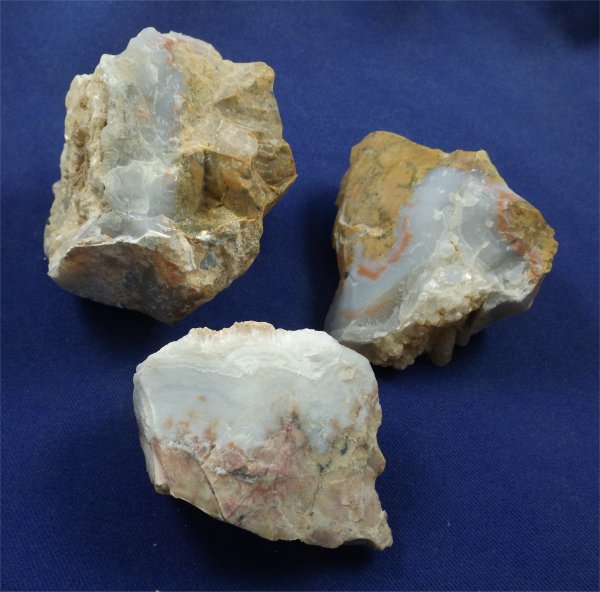
Drum Mountain Blue Agate Rough
Drum Mountain Blue Agate Rough
Drum Mountain Blue Agate Rough
Stone Type: Thousand Layer Quartz
Stone Cut: Tumbled Stones
Stone Weight: Varies
Stone Color: Varies
Size Stone Size: Varies
Location: Utah
This Is A 5 Pound Lot
History Of Drum Mountain, Utah
The history of the Drum Mountains in Juab and Millard Counties, Utah, is a rugged narrative of volcanic upheaval, ancient Indigenous stewardship, and a late 19th-century mining boom. Located roughly 25 miles northwest of Delta, this range serves as a literal "geological library" of the Great Basin, preserving millions of years of Earth's structural evolution within its arid peaks.
Geological Origins and Naming
- The Volcanic Crucible: The mountains were formed during the Tertiary Period (approximately 39 to 42 million years ago). Massive volcanic activity, including the collapse of the Thomas Caldera, produced thick layers of rhyodacite, andesite, and tuff.
- The Drum Legend: There are two competing histories for the name. One scientific theory suggests the mountains were named for their drum-like silhouette against the desert horizon. However, local lore—the "Legend of the Drum Mountains"—claims that early explorers and hermits heard mysterious, rhythmic thumping sounds echoing from the peaks, as if the earth itself were beating a drum.
Uses in Ancient Civilizations
The Drum Mountains were part of the vast traditional homelands of the Numic-speaking peoples, including the Goshute (Desert People) and the Pahvant Ute.
- Lithic Architecture: To these ancient stewards, the mountains were a vital source of "industrial" materials. The abundance of agate, jasper, and chert provided the raw stock for high-performance tools. The Goshute, masters of the arid landscape, utilized the region’s stone to architect survival—knapping arrowheads and knives that were essential for hunting and defense.
- Sacred Landscape: The range stood as a landmark in a complex network of seasonal migration, providing vantage points and mineral resources that were traded across the Great Basin for thousands of years before European arrival.
Historical Context: The Joy of Mining
The "modern" history of the range was ignited in 1872 with the discovery of gold and copper.
- The Detroit Mining District: This district was organized to manage the rush of prospectors. The primary settlement was the town of Joy, founded by mining engineer Harry Joy. At its peak, Joy was a bustling community with over 500 residents and 100 buildings.
- Mineral Diversity: While gold was the initial lure, the Drum Mountains became world-renowned for Manganese during World War II, producing over 70,000 tons of ore to support the national steel effort. The area is also geologically linked to the famous Beryllium deposits of nearby Spor Mountain.
Metaphysical Significance
In the context of the "Soul-Architecture" of the West, the Drum Mountains represent Resilient Foundations. The range has endured extreme volcanic collapses and centuries of human extraction, yet it remains a place of profound silence and "Desert Clarity." It is viewed as a site of Inner Resourcefulness, where the "rough" exterior of the desert conceals a wealth of internal treasure.
Modern Spiritual and Decorative Use
Today, the Drum Mountains are a pilgrimage site for rockhounds and stargazers. The town of Joy is now a ghost town, leaving behind only foundations and the "Legend of the Drumming" to inspire those who visit. The blue agates and jaspers recovered from this soil are prized for their "Steely Desert Energy," often used in modern grids to anchor a sense of "Unshakable Truth" into a home or workspace.
History Of Drum Mountain Blue Agate Rough
The history of Drum Mountain Blue Agate Rough is a localized geological epic centered in the high desert of West-Central Utah. Unlike globally distributed agates, this material is a site-specific treasure, deeply tied to the volcanic history of the Great Basin. Its history is one of "hidden potential"—where rough, chalky-looking exterior nodules conceal intricate, high-contrast blue and white fortifications that have been waiting in the arid soil for millions of years.
Understanding the Energy
Drum Mountain Blue Agate is known as the "Stone of the Desert Sky." In its rough form, its energy is raw, unrefined, and exceptionally grounded. It possesses a "patient" frequency, reflecting the millions of years it spent in the silence of the Utah desert. For the Soul-Architect, this rough agate represents Unmanifested Truth, providing the "structural honesty" needed to see the core of a project before the "polishing" of public perception begins.
Geological Origins and Naming
- Composition: A microcrystalline variety of Quartz ($SiO_2$), specifically Chalcedony, characterized by its concentric banding.
- The Location: Named after the Drum Mountains in Juab and Millard Counties, Utah. This region is a complex volcanic field that was active during the Tertiary period.
- The Formation: These agates formed within gas bubbles (vesicles) in volcanic rhyolite and andesite flows. As mineral-rich silica water percolated through the cooling rock, it deposited layers of blue, lavender, and grey chalcedony, often leaving a hollow center of sparkling quartz crystals.
Uses in Ancient Civilizations
While the specific "Drum Mountain" trade name is modern, the Indigenous peoples of the Great Basin—including the Ute, Goshute, and Paiute—have a vast history with the region's silica-rich stones:
- Lithic Tools: Rough agate and chert from the West Desert were essential for "Architecting Survival." They were knapped into high-performance arrowheads, scrapers, and knives due to their conchoidal fracture and extreme durability.
- Sacred Geography: The Drum Mountains were part of a wider landscape of "Power Sites." Rough stones from these mountains were often carried as "Tokens of the Land," believed to connect the traveler back to the protective spirit of the high desert.
Cultural Context
Culturally, Drum Mountain Blue Agate is a cornerstone of the Utah Rockhounding Tradition. In the mid-20th century, as the "Rockhound" movement swept across the American West, the Drum Mountains became a "proving ground" for collectors. It was historically viewed as a "test of the eye"—because the rough exterior often looks like ordinary limestone, finding a high-quality "blue core" was considered a sign of a skilled and patient prospector.
Ancient Origins and Name
The ancient origins of this material lie in the Oligocene Epoch (roughly 30 to 40 million years ago). The name "Agate" stems from the Achates River in Sicily, but the "Drum Mountain" prefix serves as a geographical "DNA marker," tethering the stone to the specific mineral chemistry of the Utah desert, which produces its unique, "steely" blue hues.
Historical Context
During the 1950s and 60s, the Drum Mountains saw a surge in amateur mining. Families from the Wasatch Front would journey into the desert to "dig for blues." This era shifted the stone's history from a "functional tool" to a "family treasure," as thousands of these rough nodules were brought home to be cut into bookends or polished into cabochons, becoming staples of Utah's local lapidary heritage.
Metaphysical Significance
Metaphysically, Drum Mountain Blue Agate Rough is used for Inner Integrity and Silent Communication. Because it is "Rough," it is believed to help the user connect with their own "raw" or "unpolished" self. It is a stone of Patience, teaching that the most beautiful parts of our character are often hidden beneath a rugged exterior and require time and pressure to be revealed.
Chakra Association
This stone is primarily aligned with the Throat Chakra due to its blue coloration, but its rough, earthy matrix grounds it deeply into the Root Chakra. It acts as a "Grounded Expression" tool, helping the Soul-Architect speak their truth with a foundation of undeniable physical reality.
Modern Spiritual and Decorative Use
Today, Drum Mountain Blue Agate Rough is highly sought after by "Naturalist" collectors who prefer the stone in its original, earth-born state. It is used in "Earth-Grids" to stabilize a home's energy. Decoratively, its rugged, "volcanic-crust" exterior provides a stark, beautiful contrast to modern interior surfaces, serving as a piece of "living desert sculpture."
At Crystals By Rob
At Crystals By Rob, we are honored to have the history of the Drum Mountains for our closing notes. This region is a testament to the power of the "Inner Build"—reminding us that the most enduring structures are formed under pressure and over vast stretches of time. We recommend minerals from this Utah landmark for anyone seeking to connect with their own "hidden potential." At Crystals By Rob, we view the Drum Mountains not just as a location, but as a symbol of the rugged persistence required to architect a life of true value and lasting legacy.
At Crystals By Rob, we are honored to have Drum Mountain Blue Agate Rough for the closing notes. This stone is a masterpiece of Utah’s geological heritage and a symbol of "Inner Potential." We recommend this rough agate for the Soul-Architect who is currently in the "foundational" stage of a new build—someone who needs to stay grounded in their own raw truth while they navigate the early, unpolished phases of a project. At Crystals By Rob, we view these rough stones as the ultimate symbols of "The Diamond in the Rough," reminding you that the most valuable parts of your vision are often protected by a layer of rugged persistence.
Product features
Product features
Materials and care
Materials and care
Merchandising tips
Merchandising tips
Share