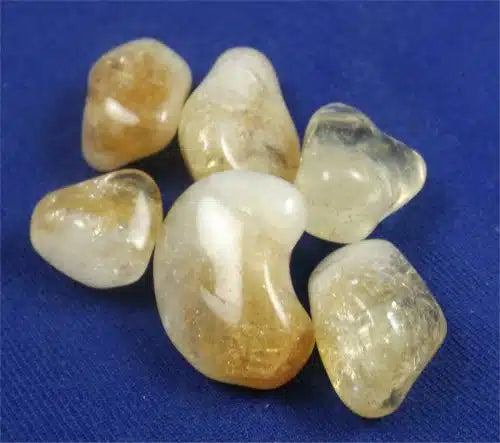
Citrine Tumbled Stones
Citrine Tumbled Stones
Citrine Tumbled Stones
Stone Type: Citrine
Stone Cut: Natural Crystal Tumbled Stones
Stone Weight: Varies
Stone Color: Yellow
Stone Size: .6 – 1 Inch
Location: Brazil
For each order of 1 stone, you will receive 1 stone at random from this lot
History Of Citrine Tumbled Stones
The history of Citrine Tumbled Stones is inextricably linked to the human desire for portable "sunlight." While large cathedral geodes or spheres served as stationary monuments of power, tumbled stones evolved as the functional, everyday "pocket talismans" of the ancient and modern worlds. These smooth, rounded gems allowed the common merchant and the traveling healer to carry the frequency of abundance without the burden of heavy, unrefined rough stones.
Understanding the Energy
Citrine is uniquely known as the "Stone of the Mind." In tumbled form, its energy is tactile and soft, radiating a constant, gentle heat. It is one of the few minerals on Earth that does not hold or accumulate negative energy; instead, it transmutes, dissipates, and grounds it. For the Soul-Architect, tumbled citrine acts as a portable battery, providing a steady stream of "solar" endurance to the wearer's auric field throughout a high-pressure day.
Geological Origins and Naming
Citrine is a macrocrystalline variety of quartz (SiO_2) that gains its golden-yellow hue from submicroscopic ferric iron (Fe^{3+}) inclusions.
- The Name: Derived from the Old French citron (lemon), it has been used to describe yellow quartz since the mid-1500s.
- The Process: Tumbled stones are created through a process of mechanical abrasion that mimics the natural action of riverbeds. Raw citrine "rough" is placed in rotating barrels with grit and water, slowly wearing away sharp edges until a polished, "liquid-like" surface is achieved.
Uses in Ancient Civilizations
- Ancient Greece: Between 300 and 150 BCE, citrine tumbled stones were frequently used as intaglios—stones carved with recessed images—set into rings and used as personal seals to authorize trade.
- Roman Empire: Romans favored the tumbled, cabochon-style citrine for protection. It was often carried by travelers to ward off the "evil eye" and protect against the venom of scorpions and snakes.
Cultural Context
In many cultures, citrine was referred to as the "Merchant's Stone." It was a common historical practice to keep a small tumbled citrine inside a cash box or a coin purse. The cultural belief was that the stone would not only attract gold but would prevent the "leaking" of wealth, ensuring that resources remained within the family or business structure.
Ancient Origins and Name
Before the 16th century, citrine was often confused with Yellow Topaz. However, ancient lapidaries distinguished it by its cooling touch and its distinct ability to "brighten" under the morning sun. Its ancient lineage is rooted in the concept of invincibility; it was believed to be a solidified ray of sunlight that could never be conquered by darkness.
Historical Context
Citrine saw a massive peak in popularity during the Art Deco period of the 1920s. While large faceted stones were used for the elite, tumbled citrine became the "people’s gem." It was widely used in costume jewelry and "good luck" charms during the Great Depression, serving as a psychological and energetic anchor of hope and future prosperity for those facing financial hardship.
Metaphysical Significance
Metaphysically, tumbled citrine is used for Manifestation and Willpower. Its smooth surface makes it ideal for "worry stones" or palm stones used during visualization exercises. It is believed to stimulate the brain, strengthening the intellect and boosting the creative imagination required to architect a new reality.
Chakra Association
Citrine is the primary stone for the Solar Plexus Chakra (3rd Chakra), the center of personal power and identity. Tumbled stones are specifically used in layout healing; placing a smooth citrine directly on the navel helps to "re-wire" the internal narrative from "I can't" to "I am."
Modern Spiritual and Decorative Use
Today, citrine tumbled stones are the most common component of "Wealth Vases" and prosperity grids. They are frequently placed in the "Wealth Corner" (the far left corner from the entrance) of a home or office to maintain a vibration of constant growth and success.
At Crystals By Rob
At Crystals By Rob, we are honored to have Citrine Tumbled Stones for the closing notes. Citrine is a cornerstone of our collection because it represents the absolute refusal to dwell in lack. We recommend Citrine for its unparalleled ability to spark the "inner sun" within the user, providing the mental clarity and unwavering confidence needed to manifest abundance. Whether carried in a pocket or placed on a desk, its vibrant energy serves as a constant reminder that you have the power to architect a life of success and joy.
Product features
Product features
Materials and care
Materials and care
Merchandising tips
Merchandising tips
Share