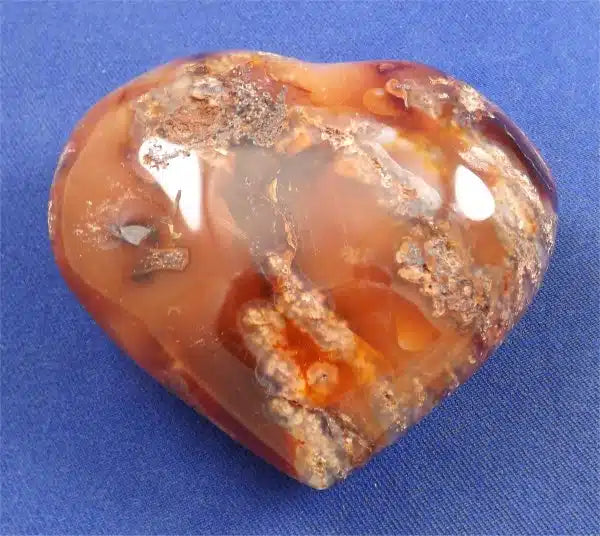
Carnelian Heart 1
Carnelian Heart 1
Carnelian Heart 1
Stone Type: Carnelian
Stone Cut: Heart
Stone Weight: 8.4 Ounces
Stone Color: Orange / Brown
Stone Size: 3.2 x 2.8 x 1.4 Inch
Location: Madagascar
The History of the Carnelian Heart: The Vessel of Vitality
The history of the "Heart" carving is a story of human symbolism meeting lapidary art. While the history of Carnelian itself stretches back over 4,500 years—to the seals of Mesopotamia and the protective amulets of Ancient Egypt—the Carnelian Heart as a specific, mass-market lapidary form is a product of the 20th and 21st centuries.
It represents the merging of the ancient "Stone of Courage" with the modern "Universal Symbol of Connection."
The Ancient Legacy: Carnelian as "Blood of the Earth"
To understand the power of a Carnelian Heart, one must first look at why Carnelian was chosen for the task of protection in the ancient world:
- The Blood of Isis: In Ancient Egypt, Carnelian was synonymous with the Tyet (the "Knot of Isis"). This knot, often carved in the shape of a loop or an ankh-like structure, represented the blood of the goddess Isis. It was a potent symbol of life, protection, and resurrection. Wearing Carnelian was a way to "bind" one’s vital life-force to the eternal.
- The Seal of Authority: Throughout the Indus Valley and Mesopotamia, Carnelian was prized for its high hardness and its ability to not stick to wax. It was the material of the administrator—the stone of those who managed the growth of a society. The ancient carnelian carver was an architect of commerce and social order.
The Evolution of the "Heart" Shape
The "heart" as a geometric symbol (the stylized heart shape we know today) has a complex history, likely evolving from representations of the ivy leaf or the seed pods of the Silphium plant in antiquity.
- The Lapidary Shift: The transition of the heart into a staple gemstone carving happened alongside the development of high-speed, diamond-tipped grinding tools in the modern era. Before mechanized tools, carving a precise, symmetrical heart out of a stone as hard as Carnelian (6.5–7 on the Mohs scale) was an incredibly labor-intensive task, reserved for royal jewelry.
- The 20th Century Metaphysical Boom: As mineral collecting shifted from an academic pursuit to a personal, spiritual one, the heart carving became the standard "giftable" form. It took the fiery, masculine, "action-oriented" energy of Carnelian and softened it, framing it within the vessel of human emotion.
The Metaphysical "Architectural" Function
At crystalsbyrob.com, we view the Carnelian Heart as a Load-Bearing Emotional Anchor.
- Vitality in the Vessel: If the heart is the center of your physical circulation, Carnelian is the center of your energetic circulation. Using this carving is an exercise in "Emotional Structuralism." It reminds the Soul-Architect that your passions are not just "feelings"—they are the fuel for your construction.
- Balancing Fire and Flow: The heart shape represents the capacity to contain emotion, while the Carnelian stone represents the power of emotion. Together, they form a perfect architectural unit: the stone provides the power, and the heart shape provides the containment, ensuring that your vital energy is directed toward your goals rather than being wasted in reactivity.
At Crystals by Rob
At Crystals By Rob, we honor the Carnelian Heart as the "Engine of the Architect." We recognize that you cannot build a life of purpose if your internal engine—your capacity for joy, courage, and motivation—is running on empty. We offer our hand-polished carnelian hearts as a structural reminder that the most ambitious projects are always built on a foundation of heart-centered passion. These aren't just decorative items; they are the "Vitality Anchors" for your home, your desk, and your daily practice.
Product features
Product features
Materials and care
Materials and care
Merchandising tips
Merchandising tips
Share