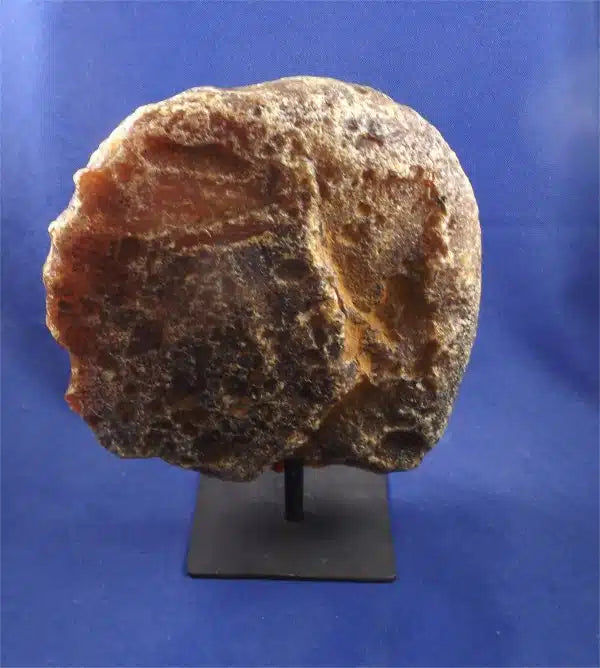
Carnelian Agate Slab On Stand
Carnelian Agate Slab On Stand
Carnelian Agate Slab On Stand
Stone Type: Carnelian
Stone Cut: Natural Crystals
Stone Weight: 4.5 Pounds
Stone Color: Clear With Oraange
Stone Size: 7.5 x 7.5 Inches
Location: Brazil
History of Carnelian Agate Slabs: The Lapidary’s Canvas
While the history of Carnelian as a gemstone dates back nearly 5,000 years to the seal-makers of Mesopotamia and the amulet-crafters of ancient Egypt, the history of the Carnelian Agate Slab is a more modern evolution. It is a story that bridges the gap between ancient ritual and the contemporary appreciation for natural geometry.
From Beads to Canvases: The Lapidary Revolution
For most of human history, lapidaries worked with what they could carry and carve by hand.
- The Ancient Limitation: In the ancient world, carnelian was prized for its durability and color, but it was almost exclusively shaped into beads, intaglios, or seals. Cutting a large, flat, uniform slab of agate was technically impossible without mechanized sawing.
- The 20th-Century Shift: The "Slab" as we know it today didn't become a standard aesthetic format until the mid-20th century, coinciding with the development of industrial diamond-tipped saws. These machines allowed lapidaries to slice through high-hardness materials like chalcedony (6.5–7 on the Mohs scale) with surgical precision, revealing the internal "architectural drawings" of the stone that had been hidden for millions of years.
Geological Artistry: The "Banding" Story
Carnelian Agate slabs are valued specifically because they reveal the rhythmic, geological history of the Earth.
- Hydrothermal Rhythms: As silica-rich water cooled in volcanic cavities, it deposited layers of quartz in pulses. Each band in a carnelian agate slab is a snapshot of an ancient environment—a moment where the temperature, pressure, or mineral concentration shifted.
- The "Window" Effect: Before modern slabbing, you could only see the outside of a nodule. Slabbing turned these stones into "windows" into geological time. It shifted the value of the stone from its shape (the carved bead) to its content (the complex, banded pattern of the interior).
The Modern Design Aesthetic
In the last 30 years, slabs have moved from the workshop into the home.
- The Interior Design Shift: Architects and interior designers began to recognize that slabs of carnelian agate, when polished to a high sheen, are effectively "Earth-art." They are no longer treated as raw material, but as focal points—used in custom cabinetry, as high-end display pieces, or as "energy anchors" in modern luxury spaces.
- The Soul-Architect’s Tool: For the modern collector, the slab represents a departure from the "small talisman" model. It is a way to occupy space. A slab doesn't just sit in your pocket; it commands a corner of your home or desk, creating a permanent, stabilized energetic zone.
At Crystals by Rob
At Crystals By Rob, we view the Carnelian Agate Slab as the ultimate "architectural draft" of the natural world. We honor the technological progress that allows us to look inside the stone, but we prioritize the geological history that created those mesmerizing, fiery bands. We offer these specimens to those who understand that your environment is an extension of your intent—and that surrounding yourself with the "Earth-Blueprints" of rhythmic, structured energy is the fastest way to manifest that same stability in your own life.
Properties Of Crystal Slabs
Product features
Product features
Materials and care
Materials and care
Merchandising tips
Merchandising tips
Share