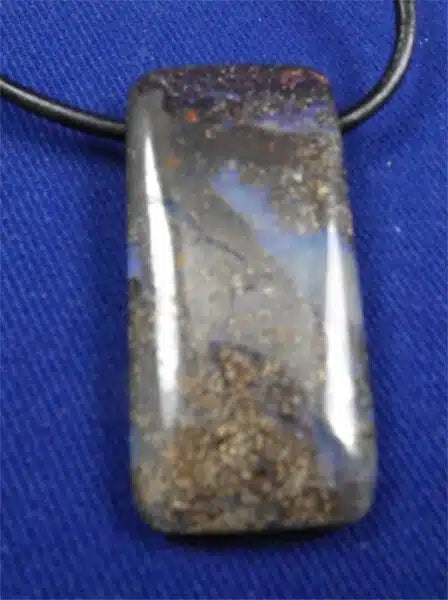
Boulder Opal Pendant
Boulder Opal Pendant
Boulder Opal Pendant
Stone Type: Boulder Opal
Stone Cut: Pendant
Stone Color: Brown Matrix with Blue White Opal
Stone Size: 1.72 x .77 Inches
Location: Australia
Comes on a 18 inch leather cord necklace
The History of Boulder Opal: The Earth’s Natural Doublet
Boulder Opal represents a unique chapter in gemological history, specifically tied to the rugged outback of Western Queensland, Australia. Unlike other opals that are cut as solid gems, Boulder Opal is "geologically married" to its host rock—ironstone. Its history is one of extreme environmental endurance, accidental discoveries, and a mid-century resurgence that turned a "miner's ignored byproduct" into one of the most artistically valued stones in the world.
Geological Origins: The "Ironstone Cradle"
The history of Boulder Opal began roughly 100 to 140 million years ago during the Cretaceous period, when a vast inland sea covered central Australia.
- The Silica Seepage: As the sea receded, it left behind silica-rich sediment. Over millions of years, heavy weathering dissolved this silica, which then trickled down into the cracks and hollows of the underlying ironstone boulders (sedimentary rocks composed of hematite and goethite).
- The Natural Doublet: Because the opal formed in very thin veins within these hard boulders, it was often impossible to separate the gem from the rock without breaking it. This created "Earth's natural doublets," where the dark brown ironstone serves as a permanent, natural backing that makes the opal’s "play-of-color" appear more vibrant and electric.
- Fossil Wood Replacement: A unique subset of Boulder Opal history involves opalized wood. In the Winton formation, ancient tree fragments were replaced by precious opal, preserving the organic cellular structure of the wood in shimmering rainbow hues.
The 19th Century: Discovery and Disregard
The modern history of Boulder Opal is centered on the pioneers of the Queensland outback.
- First Discoveries (1869–1872): The first recorded discovery of Boulder Opal occurred in 1869 at Listowel Downs, near Blackall, Queensland. Shortly after, in 1872, mining began in the broader Barcoo River region.
- Introduction to the World (1889): Tullie Cornthwaite Wollaston, a key figure in opal history, took 60 pieces of Queensland Boulder Opal to London in 1889. While met with initial suspicion by diamond-focused merchants, the stone’s brilliance eventually caught the eye of the legendary Queen Victoria, who became a lifelong lover and collector of Australian opals.
- The "Second Class" Gem: Despite its beauty, Boulder Opal was largely ignored by early miners in favor of "Pipe Opal" or solid seams that could be cut into traditional cabochons. Because Boulder Opal required "freeform" cutting to preserve the thin veins, it was considered less valuable than the solid opals found at White Cliffs or Lightning Ridge.
The Modern Resurgence: The Artist’s Choice
After a long period of decline due to extreme droughts and the popularity of Black Opal, Boulder Opal experienced a massive revival in the 1960s and 1970s.
- The 1970s Boom: Independent miners began using heavy machinery to rework old claims in fields like Quilpie, Yowah, and Winton. The "undulating" and "freeform" nature of Boulder Opal suddenly appealed to "progressive" jewelry designers who moved away from rigid symmetry in favor of organic, one-of-a-kind shapes.
- The Yowah Nut: This era popularized the Yowah Nut, a world-exclusive variety of Boulder Opal found only in the Yowah field. These are small, nut-shaped ironstone concretions that, when cracked open, reveal a "kernel" of brilliant precious opal.
Metaphysical History: The Grounded Visionary
In spiritual history, Boulder Opal is regarded as the "Stone of Serenity."
- Linking the Worlds: Historically, it is used to bridge the Root Chakra (represented by the earthy ironstone) with the Crown and Third Eye Chakras (represented by the shifting opal colors). It is believed to help the user stay grounded during periods of intense spiritual expansion.
- Perseverance and Stability: Because the opal is literally "bonded" to its rock, it has historically been used as a talisman for perseverance and emotional stability. It is the stone for those navigating major life changes who need to remain "unshakeable" yet "radiant."
At Crystals by Rob
At Crystals By Rob, we value Boulder Opal as a "Masterpiece of Connection." We honor the millions of years of pressure that fused the iron of the earth with the rainbow of the sky. We offer these stones to the creators and the "Life-Shifters" of our community—reminding you that your most beautiful "flashes" are often supported by the strongest, most weathered parts of your own history.
Product features
Product features
Materials and care
Materials and care
Merchandising tips
Merchandising tips
Share