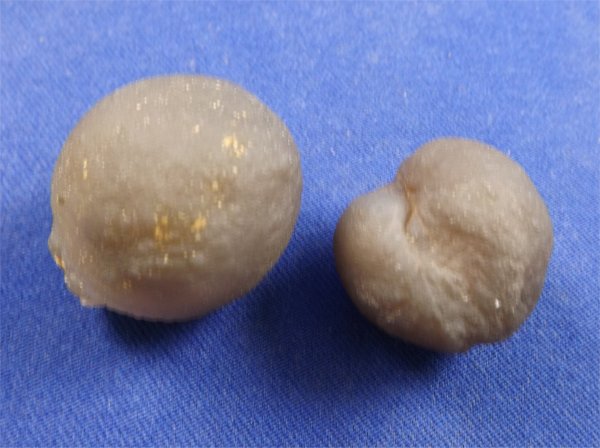
Botryoidal Chalcedony Large
Botryoidal Chalcedony Large
Botryoidal Chalcedony Large
Stone Type: Chalcedony
Stone Cut: Natural Balls
Stone Weight: Varies
Stone Color: Clear / Grey
Stone Size: .9 – 1,1 Inches
Location: Brazil
For each order of 1 stone, you will receive 1 stone at random from this lot
The Architecture of Botryoidal Chalcedony
In the mineral kingdom, the term "botryoidal" is derived from the Greek botrys, meaning "a bunch of grapes." It describes a specific growth habit where a mineral forms in globular, rounded aggregates rather than the sharp, geometric points typical of traditional quartz.
When this habit occurs in chalcedony—a cryptocrystalline form of silica comprised of intergrowths of quartz and moganite—it creates one of the most structurally fascinating specimens in the geological record.
The Geological Formation: Radial Growth
Understanding the formation of botryoidal chalcedony requires a look at fluid dynamics within the Earth’s crust. These structures do not grow from a single point; they grow from a multitude of nuclei—such as dust, sand grains, or other small particulates—within a cavity.
- Nucleation and Outward Expansion: These nuclei act as "seeds." As silica-rich groundwater percolates into cavities (often within volcanic or sedimentary rock), it begins to deposit silica layers around these seeds.
- Consistent Velocity: Unlike crystals that favor specific axes, botryoidal minerals grow outward radially at a consistent speed in all directions. As these spheres expand, they eventually collide with neighboring spheres, fusing together to create the smooth, undulating, "bubbly" surface that defines the specimen.
- The Role of Moganite: Technical analysis of these specimens often reveals a mixture of quartz and moganite. The presence of moganite is a hallmark of chalcedony, distinguishing it from macrocrystalline quartz and contributing to its waxy, often translucent luster.
Nomenclature: The "Grape" Trade Name
While the term "botryoidal chalcedony" is the accurate mineralogical descriptor, you frequently see these specimens marketed as "Grape Agate"—particularly when the specimen exhibits the rich purple hues found in deposits such as those in Sulawesi, Indonesia.
It is important to note, however, that in the strict mineralogical sense, these are rarely "true" agates. True agate requires concentric, layered banding. While botryoidal formations may display layering, the "bubbly" surface is a function of the growth habit, not necessarily the internal banding that defines agate.
Assessing Quality and Structural Integrity
For collectors and business owners, assessing these specimens often comes down to the integrity of the "grapes":
- Intact Spheres: The value of a specimen is directly tied to the completeness of the botryoidal clusters. Scuffs, abrasions, or broken "bubbles" are considered significant structural defects.
- Luster and Translucency: High-quality specimens often feature a druzy quartz dusting over the chalcedony, which provides a sparkling contrast to the smooth, waxy luster of the underlying spheres.
- Saturation: In colored varieties, the color is often derived from trace inclusions (such as iron or manganese). Deep, saturated colors are the primary driver of market rarity and value.
At Crystals by Rob
At Crystals By Rob, we treat botryoidal chalcedony as a masterclass in nature’s structural geometry. It is a material that reminds us that complexity is often built upon the simplest of foundations—in this case, a tiny grain of sand serving as the anchor for a massive, organic growth.
Product features
Product features
Materials and care
Materials and care
Merchandising tips
Merchandising tips
Share