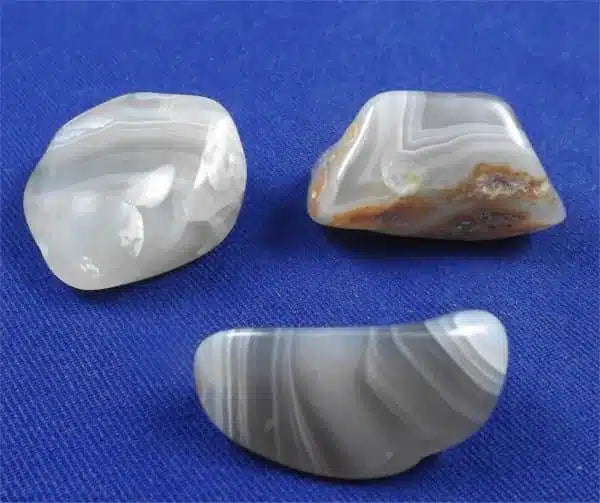
Blue Lace Moroccan Agate Tumbled Stones
Blue Lace Moroccan Agate Tumbled Stones
Blue Lace Moroccan Agate Tumbled Stones
Stone Type: Agate
Stone Cut: Tumbled Stones
Stone Color: Blue / Grey
Stone Weight: Varies
Stone Size: 1 – 1.7 Inches
Location: Morocco
For each order of 1 stone, you will receive 1 stone at random from this lot
The History of Blue Lace Moroccan Agate: A New Horizon of Calm
While the world’s most famous Blue Lace Agate originates from the deserts of Namibia, the emergence of Moroccan Blue Lace Agate marks a fascinating new chapter in lapidary history. Discovered in the rugged Atlas Mountains, these tumbled stones are a testament to Morocco’s rich geological diversity. While Namibian material is often defined by its "Space-Age" sky-blue and white bands, the Moroccan variety offers a deeper, more atmospheric history, often featuring a wider spectrum of moody blues, grays, and translucent "smoke" patterns.
The Geological Context: The Atlas Mountains
Unlike the volcanic sills of Namibia, Moroccan Blue Lace Agate is birthed in the Atlas Mountains, a range formed by complex tectonic activity over millions of years.
- High-Altitude Deposition: These agates formed within the cavities of ancient basaltic and rhyolitic volcanic rocks. As silica-rich groundwater percolated through these mountain fissures, it deposited the characteristic "lace" bands that define the variety.
- The Moroccan Palette: Because of the unique mineral composition of the Moroccan soil—rich in iron and other trace elements—Moroccan Blue Lace often features a "steely" or "indigo" undertone. Historically, miners in regions like Sidi Rahal and the Middle Atlas have found these blue-gray nodules tucked among more common red and orange varieties.
The Discovery: A 21st-Century Emergence
While Moroccan agates have been collected for decades, the specific "Blue Lace" variety from this region began to gain significant global attention in the early 2000s.
- The Artisanal Boom: Much of the history of Moroccan stones is artisanal. Local miners—often families who have lived in the mountains for generations—began to identify "Blue Seams" that mirrored the legendary Namibian material.
- Tumbled for Transparency: When these Moroccan nodules are tumbled, they reveal a unique transparency that differs from other African sources. The tumbling process highlights the internal "vistas" and "smoke" layers, making them highly prized for their depth and "internal light."
The Metaphysical Shift: The "Steely" Protector
As Moroccan Blue Lace Agate tumbled stones entered the market, practitioners noticed a distinct vibrational difference from their Namibian cousins:
- Grounded Communication: While the traditional sky-blue lace is about "soft speech," the Moroccan variety—with its deeper blue and gray tones—is historically viewed as a stone of "Protected Communication." It is used by those who need to speak their truth in high-pressure or "steely" environments.
- The Mental Shield: In the history of Moroccan lapidary arts, these stones are often kept as talismans for mental clarity. The "lace" patterns are seen as a map for navigating complex emotional landscapes without losing one’s cool.
At Crystals by Rob
At Crystals By Rob, we value the Blue Lace Moroccan Agate for its "Mountain Strength." We honor the Moroccan miners who traverse the Atlas heights to bring these moody, beautiful treasures to light. We offer these tumbled stones as the "Diplomat's Anchor"—a tool for those who seek to communicate with both the softness of the sky and the unshakeable strength of the mountains.
Product features
Product features
Materials and care
Materials and care
Merchandising tips
Merchandising tips
Share