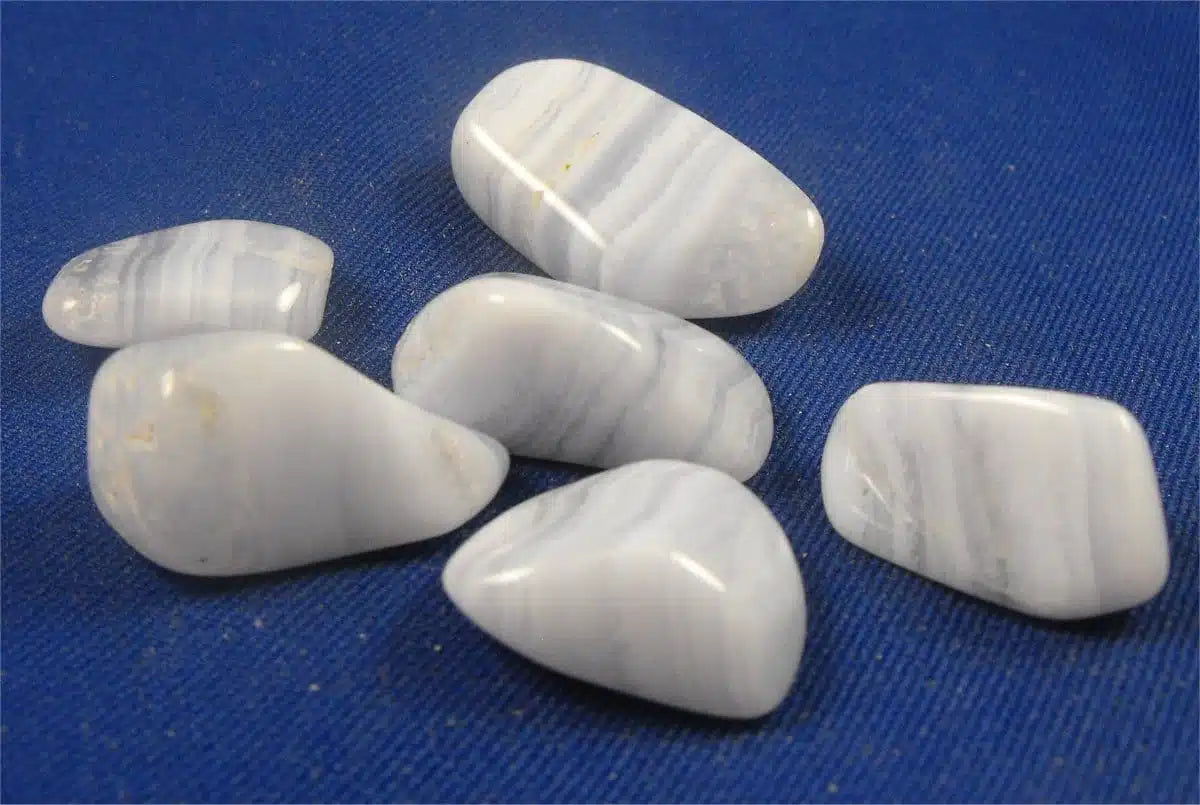
Blue Lace Agate Tumbled Stones
Blue Lace Agate Tumbled Stones
Blue Lace Agate Tumbled Stones
Stone Type: Blue Lace Agate
Stone Cut: Natural Crystal Tumbled Stones
Stone Weight: Varies
Stone Color: Blue
Stone Size: .75 – 1 Inch
Location: Namibia
For each order of 1 stone, you will receive 1 stone at random from this lot
The History of Blue Lace Agate Tumbled Stones: From the Kalahari to the Global Stage
While many varieties of Agate have been used for amulets and seals since the time of the Ancient Greeks, Blue Lace Agate has a much more recent and focused history. Known for its delicate, sky-blue bands and "lace-like" patterns, this stone’s journey from a remote desert discovery to a staple of the tumbled stone market is a testament to its unique beauty and calming frequency.
The Discovery: George Swanson’s Find
The modern history of Blue Lace Agate is inextricably linked to one man: George Swanson.
- The Ysterputs Mine: In the early 1960s, Swanson discovered the first significant deposit of this specific banded chalcedony on the Ysterputs farm in Namibia, located in the southwestern corner of Africa.
- The "Gem of Sanity": Swanson, who was deeply attuned to the mineral's energy, famously referred to Blue Lace Agate as the "Gem of Sanity." He spent decades mining and protecting the deposit, ensuring that the stone reached the world market while maintaining its integrity.
- A Singular Source: For nearly half a century, the Namibia deposit remained the primary (and most high-quality) source of Blue Lace Agate, making it a "specialty" stone of Southern Africa.
The Rise of the "Tumbled" Aesthetic
In the 1970s and 80s, as the "New Age" movement grew and lapidary technology became more accessible, Tumbled Stones became the preferred way for the public to interact with Blue Lace Agate.
- Durability for the Tumbler: Agate has a hardness of 7 on the Mohs scale, making it ideal for the tumbling process. When raw, craggy pieces of Blue Lace are tumbled for weeks in abrasive grit, they emerge as smooth, "worry stones" that highlight the intricate, white-and-blue banding that is often hidden in the rough material.
- Accessibility: While large, museum-grade slabs were expensive, tumbled stones allowed collectors and healers to own a piece of this rare Namibian treasure for a fraction of the price.
The Metaphysical Legacy: The Stone of the Throat
As Blue Lace Agate tumbled stones circulated through the global community, they became legendary for their specific "Signature":
- The Communication Stone: In the 1980s and 90s, Blue Lace Agate became firmly established in metaphysical literature as the premier stone for the Throat Chakra. Its soft blue color and circular patterns were seen as a visual representation of a calm, clear voice.
- The Antidote to "Hot" Emotions: Historically, healers have used these tumbled stones to "cool" the heat of anger or anxiety. The act of holding a cool, smooth Blue Lace Agate was—and still is—prescribed for those who need to speak their truth with gentleness.
Current Status and Rarity
Today, the history of Blue Lace Agate is entering a "Precious" phase.
- Supply Constraints: The original mines in Namibia have faced significant production hurdles and depletion over the years. While new deposits have been found in places like Brazil, the "Namibian Blue" remains the gold standard for its deep color and tight, lace-like banding.
- Investment Pieces: Because of the dwindling supply of high-grade rough material, even tumbled stones are now being viewed as "investment minerals," as the clarity and "lace" patterns become harder to find in large quantities.
At Crystals by Rob
At Crystals By Rob, we treat every Blue Lace Agate Tumbled Stone as a piece of "Condensed Calm." We honor the legacy of George Swanson and the Namibian miners who first brought this sky-colored treasure to light. We offer these tumbled stones as essential tools for the modern communicator—reminding you that your truth is most powerful when spoken with the clarity and softness of the desert sky.
Product features
Product features
Materials and care
Materials and care
Merchandising tips
Merchandising tips
Share