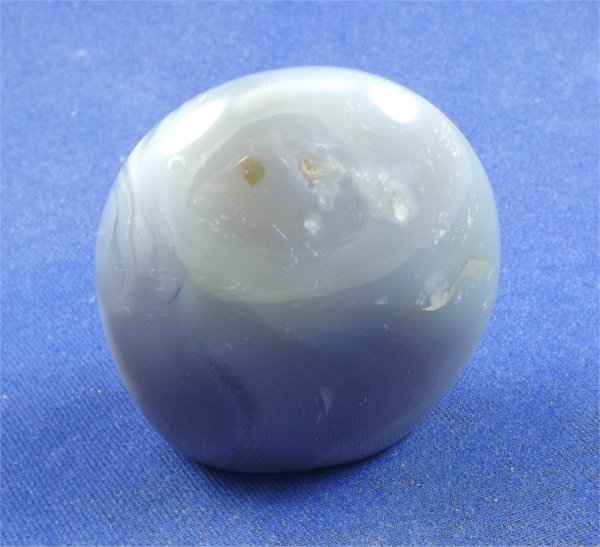
Agate Freeform 1
Agate Freeform 1
Agate Freeform 1
Stone Type: Agate
Stone Cut: Freeform
Stone Color: Grey / Blue
Stone Weight: 5.1 Ounces
Stone Size: 2.3 x 2.1 x 1.2 Inches
Location: Madagascar
History of Agate Dome-Shaped Crystals
The history of Agate dome-shaped crystals is a story of "Earthly Fortification" and the ancient human desire to see the hidden layers of the world. While many crystals are valued for their clarity, Agate has always been prized for its complex, banded internal structures. The dome shape—or cabochon—is the traditional lapidary cut used to "reveal the heart" of the Agate. By rounding the top of the stone, light is forced to travel through the various microscopic layers of chalcedony, creating a three-dimensional view of the Earth’s slow, rhythmic history.
Understanding the Energy
The energy of an Agate dome is exceptionally stable, cooling, and protective. Because Agate is a stone of Slow and Steady Progress, the dome shape acts as an "Energetic Anchor." The flat base grounds the stone’s vibration into the physical plane, while the curved surface creates a soft, protective "bubble" of energy. It is a stone of Composure and Functional Harmony, designed to help the wearer or the environment stay calm under pressure. It doesn't provide a sudden "jolt" of energy; instead, it provides a reliable, background frequency of security.
Geological Origins and Naming
Agate is a variety of banded Chalcedony, a mineral of the Quartz family ($SiO_2$). It forms in the voids of volcanic rocks or ancient lavas, where silica-rich water slowly deposits layers over thousands of years. The name "Agate" was given by the Greek philosopher Theophrastus, who discovered the stone along the shore of the Achates River in Sicily (now the Dirillo River) around the 4th century BCE. The "Dome" shape is the most ancient way of polishing Agate, as its toughness (6.5 to 7 on the Mohs scale) made it ideal for creating rounded, durable amulets.
Uses in Ancient Civilizations
In Ancient Sumeria and Babylon, Agate domes were carved into "Eye Beads" and seals. The natural banding often created "eye" patterns that, when polished into a dome, were believed to deflect the "Evil Eye" of jealousy and malice. In Ancient Egypt, Agate domes were used in jewelry and ritual vessels to protect against spiders and scorpions, and were believed to turn back storms. The Ancient Greeks and Romans utilized Agate domes for intaglios and cameos, where the different colored layers were meticulously carved to create miniature portraits and mythological scenes that "rose" out of the stone's curved surface.
Cultural Context
Culturally, the Agate dome is the stone of "The Diplomat" and "The Protector of the Home." It represents the ability to remain balanced and articulate during difficult negotiations. In German history, specifically in the town of Idar-Oberstein, Agate cutting and dome-polishing became a world-renowned industry starting in the 15th century. This cultural heritage cemented Agate as a "Stone of Craftsmanship," representing the human ability to take a rough, unassuming nodule and reveal its intricate, inner beauty through patience and skill.
Ancient Origins and Name
The practice of smoothing Agates into rounded mounds is as old as the first river stones gathered by humans. These were often called "Banded Earth Hearts" or "Victory Stones." The name "Dome" highlights the stone's role as a "protective ceiling" for the spirit. It teaches us that true strength is built layer by layer, and that our most beautiful "patterns" are often found on the inside, requiring time and focus to be revealed.
Historical Context
Historically, Agate has been the "Stone of the Gardener." During the Middle Ages, Agate domes were tied to the horns of oxen or worn by farmers to ensure a bountiful harvest and to protect crops from frost. In the Victorian Era, "Scottish Pebble Jewelry" utilized Agate domes and slabs from the Highlands to create sentimental pieces that connected the wearer to the rugged, enduring spirit of the land. The transition to modern "energy domes" reflects our contemporary understanding of Agate’s ability to harmonize the yin and yang, providing a balanced energetic environment.
Metaphysical Significance
Metaphysically, an Agate dome is a "Shield of Emotional Stability." It is used to "smooth out" chaotic environments and to help the individual process repressed emotions in a safe, contained way. Because of the dome shape, it acts as a "Vibrational Buffer," absorbing the "noise" of modern life—such as electromagnetic smog and social stress—and neutralizing it within its banded layers. It is a stone of Self-Acceptance and Concentration, helping you to look at your own "layers" with clarity and without judgment. It encourages a slow, rhythmic approach to life that prevents burnout.
Chakra Alignment
The Agate dome resonates most powerfully with the Root Chakra and whatever chakra corresponds to its specific color (e.g., Blue Lace Agate for the Throat, Moss Agate for the Heart). By anchoring the Root, it provides the physical "safety net" needed to explore higher states of consciousness. The dome shape helps to "ground the crown," ensuring that your spiritual insights are practical and applicable to your daily life. It creates a "Stabilizing Loop" that pulls frantic energy down from the head and anchors it firmly into the Earth.
Modern Spiritual and Decorative Use
Today, Agate domes are favorites for those who practice "Feng Shui" or want to create a "Calm Zone" in a busy office. They are often placed in the "Family" or "Health" sectors of a home to promote longevity and harmonious communication. Decoratively, their intricate banding and architectural shape make them "Timeless Classics" in any interior design, symbolizing a life that is Grounded, Balanced, and Secure. For the modern seeker, the Agate dome remains a symbol of Resilience, reminding us that our history—and all its layers—is what makes us strong.
At Crystals by Rob
At Crystals by Rob, we are honored to have Agate dome-shaped crystals for anyone seeking to bring a sense of stability, protection, and functional harmony into their life. Their ancient, banded energy and stable, rounded shape make them an ideal choice for Root Chakra healing, emotional buffering, and maintaining a "peaceful sanctuary" in any environment. We recommend an Agate dome as a "Foundation Stone" for your collection, providing a reliable, cooling anchor through the ups and downs of your journey. For more information and to view our latest uniquely banded specimens, please visit us at crystalsbyrob.com.
Product features
Product features
Materials and care
Materials and care
Merchandising tips
Merchandising tips
Share